From Greenwich to Herstmonceux
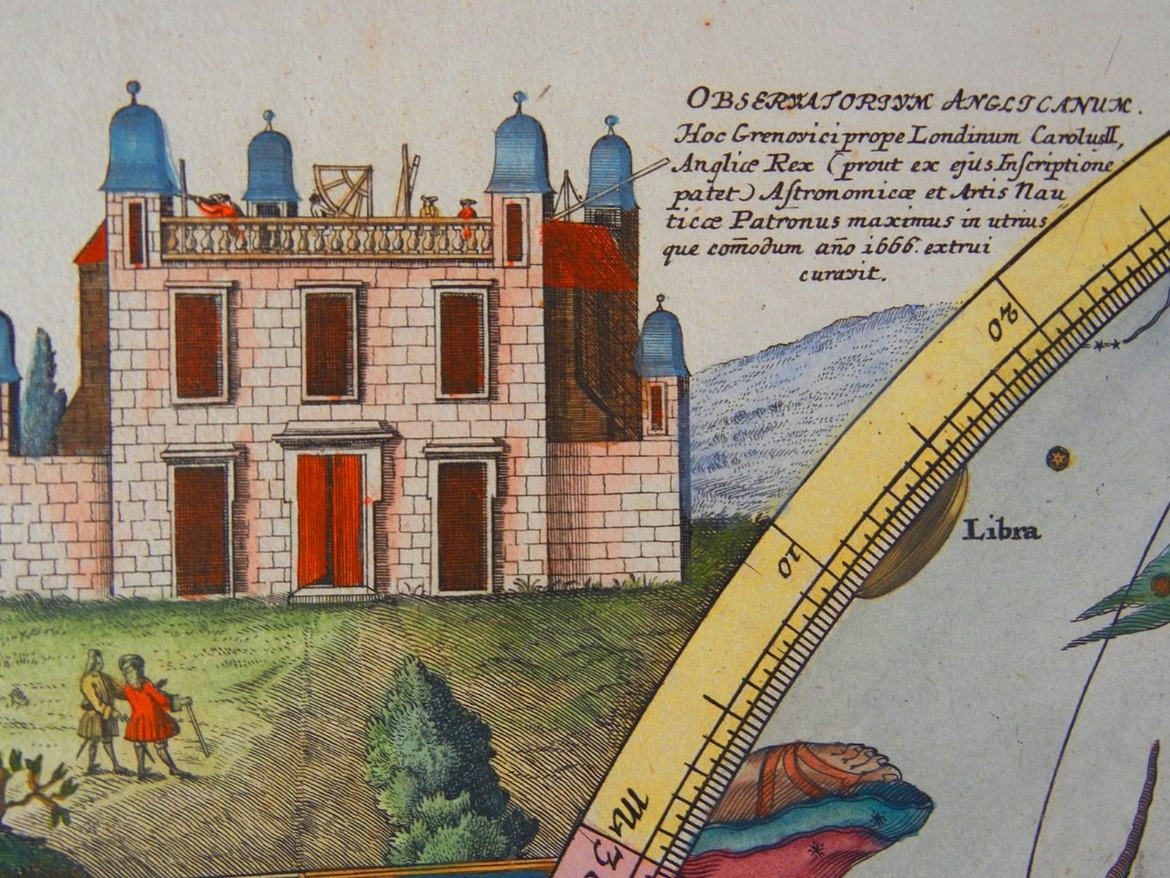
The Royal Observatory was founded by King Charles II on 4th March 1675 when John Flamsteed was appointed by royal warrant to become ‘The King’s Astronomical Observator’, the first Astronomer Royal, with an allowance of £100 a year. About a year later Flamsteed was given a stipend of just £500 to build an Observatory at Greenwich. The money was given together with ‘spare bricks from the Tilbury Fort’; and some timber, iron and lead from a demolished gatehouse at the Tower of London.
The purpose of the Royal Observatory was a practical one: to reduce the loss of ships at sea. At that time mariners had no accurate way of working out their position when out of sight of land. They could find their latitude (north-south position) by observing the sun or stars, but not their longitude (east-west position). As a result many sailors’ lives were lost when their ships struck rocks unexpectedly or were otherwise lost. The original purpose therefore was to determine longitude by producing accurate star maps. By the 1770s the problem of longitude had been solved using two methods. One answer was for a ship’s captain to carry a reliable clock to keep ‘Greenwich Time’ throughout the voyage. Alternatively he could use the Moon as a clock by measuring its position in the sky, relative to nearby stars, and referring to a detailed set of tables prepared annually at Greenwich. Armed with either of these timekeepers, or preferably both, mariners could make their own astronomical observations on board ship, and use them to work out their position anywhere on Earth.
Solving the problem of longitude didn’t mean the Observatory had nothing to do. The essential work of measuring time and compiling tables went on from year to year, and the Greenwich astronomers developed new interests too. In particular they began to do research, studying the stars and other objects in the sky, to find out what they are and how they work.
The Admiralty took over the funding of the Observatory in 1818 and it remained Admiralty funded until 1965 when the Science Research Council (SRC) was formed and brought the funding of all UK astronomy under the same umbrella.
The Royal Greenwich Observatory Moves to Herstmonceux
As early as the nineteenth century, observing conditions in London had deteriorated markedly. The city’s smoky air and bright lights meant that astronomers could no longer study faint objects in the night sky. By the early twentieth century, London had expanded so much that Greenwich was enveloped. In the 1920s nearby train lines were electrified which interfered with the Magnetic Observatory and this department had to be relocated to Abinger. In 1933, Spencer Jones was appointed as the Astronomer Royal, and he began plans to relocate the rest of the observatory to a better site but plans were put on hold because of the outbreak of World War II.
Over 70 possible sites for the new observatory were considered. From these, the Astronomer Royal, in consultation with the Admiralty, the Department of the Civil Engineer-in-Chief, the Director of the Meteorological Office and the Director of the Geological Survey drew up a short list of just five: Herstmonceux Castle, Hinton Ampner House near Winchester, Hackwood House near Basingstoke, Amport House near Andover and Kingston Maurward near Dorchester. The final decision was made in April 1946 – it was announced that the Observatory would be moving to Herstmonceux and the name was changed to The Royal Greenwich Observatory, Herstmonceux – the RGO.
Building the Observatory at Herstmonceux
The building was constructed to house three reflecting and three refracting telescopes in the six green domes. It is known as the ‘Equatorial Group’ after the way the telescopes are mounted. The architect was Brian O’Rorke and the work was completed in 1958. With its unique arrangement of domes around a central bastion the Equatorial Group was one of the most important government commissioned building projects of its period. The domes were clad in copper sheet and coated with a chemical that has helped them to weather to today’s distinctive green – one of the features that was intended to make the buildings blend into the Sussex countryside. Modern observatories now have domes painted white or silver to reflect away any daytime heat. The base of the domes were faced with wood-burnt West Sussex brick. The balconies and window surrounds finished in Portland stone; the terrace paved in Yorkstone with Portland stone steps and edgings. The external walls were clad in knapped flint – a traditional Sussex finish, which was a further attempt by the architect to help the buildings ‘blend in’. Flint knapping is an ancient skill, also used to make stone tools and weapons, in which lumps of flint are shaped by striking them with preciselyaimed blows; in this case to form cubes with glassy blue sides. In the 1950’s it proved difficult to find a flint knapper with the appropriate skills, but eventually a 90 year old gentleman from Lewes, East Sussex, was coaxed out of retirement. The buildings were finished to the highest standards and at considerable cost. However, astronomers found the layout inconvenient and even hazardous. Look around the site – at the various levels and walkways, and imagine this in the dark with few of the current railings in place. There are tales of the occasional stumble into the lily pond.
Working at the Observatory
The transfer began in 1947, and by 1958 the Royal Greenwich Observatory was fully up and running at Herstmonceux. At its peak, over 200 people worked at the Observatory in Herstmonceux and lived in the local community. The people who actually operated the telescopes at Herstmonceux were called ‘night observers’. They were on duty every night when the sky was clear and the Moon not too bright. On the Thompson 26-inch telescope, for example, the night observer’s job was to line up the telescope on a succession of specified points in the sky, working from a prearranged list of ‘shots’, and to load in a photographic plate for each shot and expose it for a time that usually ranged from five minutes up to an hour or more. It was precision work which required much care and skill. Cold was a great enemy, since the domes had to be unheated to prevent currents of warm air blurring the photographs.
During its days at Herstmonceux, the RGO built up an enviable reputation for world-class astronomical research. Each year Herstmonceux Castle was the venue for a major conference attracting top astronomers from all over the world. The RGO was responsible for the careful mapping of star positions and monitoring of solar activity and, together with the US Naval Observatory in Washington DC, it produced annual almanacs which contained the carefully computed positions of the sun, moon, planets and stars for every day of the year.
The RGO was also responsible for the provision of a national time service. It was from the RGO’s atomic clocks at Herstmonceux that the familiar ‘six-pips’ were sent by land-line to the BBC for broadcast.
The end of the RGO
Unfortunately, the unreliable British weather meant that the telescopes could not be utilised as much as they should have been. With the advent of cheap air travel in the sixties it became feasible for astronomers to travel to other observatories in order to use telescopes in the best possible locations. Eventually, the decision was taken to establish a major overseas observatory in the northern hemisphere and to move the one of the telescopes (the Isaac Newton Telescope) there, where it could be put to better use. In 1979 the telescope was dismantled, removed from its dome and completely refurbished before being installed on top of an extinct volcano on the Canary Island of La Palma in 1984. Here it formed part of the International ‘Roque de los Muchachos Observatory’ run as an overseas facility by the RGO. With one of its main telescopes located abroad, resources for maintaining the instruments at Herstmonceux diminished and they were used less and less. Eventually, in 1990, the decision was taken to move the Observatory again, this time to a new site at Cambridge, adjacent to the University’s Institute of Astronomy.
The Observatory Science Centre and Museum
When the estate passed into the hands of Queen’s University of Kingston, Ontario, Canada, Science Projects (our charity) proposed the idea of a ‘hands-on’ science centre, located in the old telescope buildings. The proposal was backed by both the local district and county councils and, as a forerunner to the permanent centre, a travelling exhibition known as the Discovery Dome visited the site for three months during the summer of 1994. The Observatory Science Centre opened in April 1995. An extensive programme of repair and upgrading of the buildings and telescopes was completed in 2004 with the aid of a substantial grant from the National Heritage Lottery Fund. It is now a Grade II* listed monument. The Observatory Science Centre and Museum is a major venue for exhibitions, lectures and educational programmes and the renovated telescopes provide a unique opportunity for the public, schools and astronomical societies to see the night sky.